

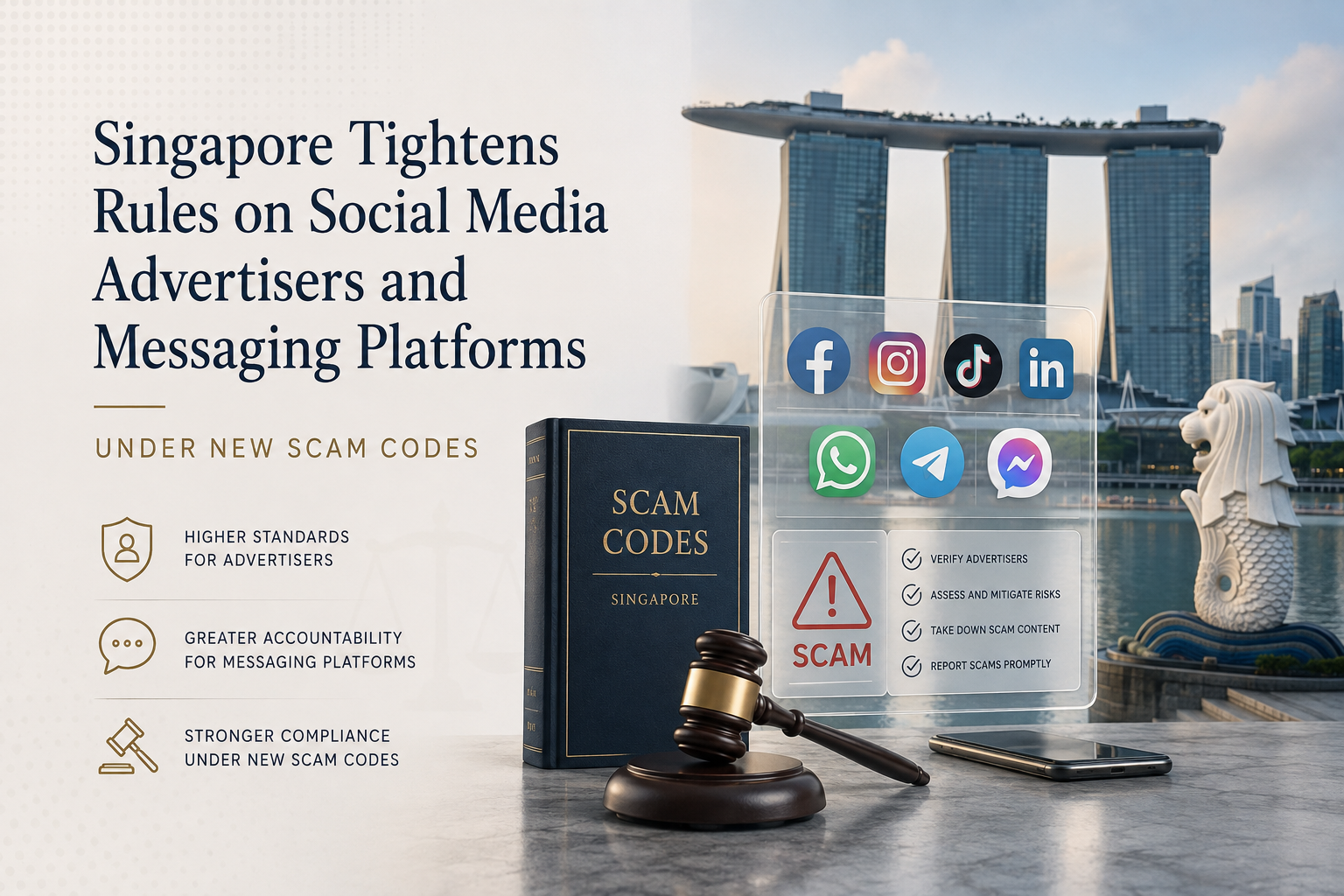
The Singapore Police Force (SPF) has issued three new Codes of Practice under the Online Criminal Harms Act, requiring social media platforms to verify advertisers, messaging apps to flag unknown contacts, and e-commerce platforms to strengthen login safeguards, with most requirements taking effect by 31 January 2027.
What Did the Police Announce?
On 17 August 2026, the Singapore Police Force’s Online Criminal Harms Act (OCHA) Office issued a new Code of Practice for Online Messaging and Conferencing Services, a new Code of Practice for Social Media Services replacing the earlier Online Communication Services Code, and an enhanced Code of Practice for E-Commerce Services. These Codes build on measures introduced in June 2024, which SPF credits with helping reduce scam cases on designated platforms by about 37 percent between 2024 and 2025. A recent Ministry of Digital Development and Information survey found that more than four in five Singapore residents had encountered harmful online content, most commonly content linked to scams, prompting the update.
Which Platforms Are Covered?
The Messaging Code applies to WhatsApp, Telegram, WeChat, Apple iMessage, Apple FaceTime, Google Message and Google Meet. The Social Media Code applies to Facebook, Instagram and TikTok. The enhanced E-Commerce Code continues to apply to Carousell, Facebook Marketplace and Facebook Business Pages. Compliance is required by 31 January 2027, except for messaging safeguards against impersonation of Singapore government officials, which must be in place by 30 September 2026 given the urgency of that scam variant.
What Will Advertiser Verification Require?
For SME owners and marketing teams, the most significant change is on the Social Media Code. Platforms must verify an advertiser’s identity against government-issued records before allowing that advertiser to publish ads targeting Singapore users. Platforms must also proactively block advertisements suspected of furthering a scam, including checking for URL cloaking, promptly remove reported or suspected scam ads, and disallow advertisements for financial products or services unless the advertiser is licensed by the Monetary Authority of Singapore or another relevant Singapore authority. Businesses running ads on Facebook, Instagram or TikTok should expect new onboarding or authentication steps, and should ensure any financial promotions are backed by the correct licences before campaigns go live.
What Changes for Messaging Platforms?
Messaging platforms must obtain a user’s consent before an unknown contact can add them to a group or channel, display contextual warnings such as account creation date or country of origin for suspicious accounts, and give users the option to silence, filter or block unfamiliar contacts. These measures target investment scams and impersonation of government officials, which together account for a significant share of scam cases on messaging apps.
What Happens If a Platform Does Not Comply?
Under the current framework, failure to comply with a Rectification Notice is an offence carrying a fine of up to S$1 million, with continuing offences attracting a further S$100,000 per day. The Ministry of Home Affairs has proposed amendments, tabled in Parliament in August 2026, that would raise financial penalties to up to S$10 million per instance of non-compliance with a Code, and up to S$10 million plus S$300,000 per day for continuing breaches of a Rectification Notice or Compliance Order. Further details are expected at the Second Reading of the Scams (Countermeasures) and Other Matters Bill in September 2026.
What Should Businesses Do Now?
Companies advertising on the affected platforms should review their advertiser account documentation, confirm licensing status for any financial promotions, and brief marketing teams on the new verification steps. Businesses using WhatsApp or Telegram for client communication should also review internal practices for engaging with unfamiliar contacts.
If your business needs advice on compliance with the new Codes of Practice, advertising licensing requirements, or updating internal policies for online client communication, OTP Law Corporation can help. Contact us today at https://otp.sg/contact-us.


