

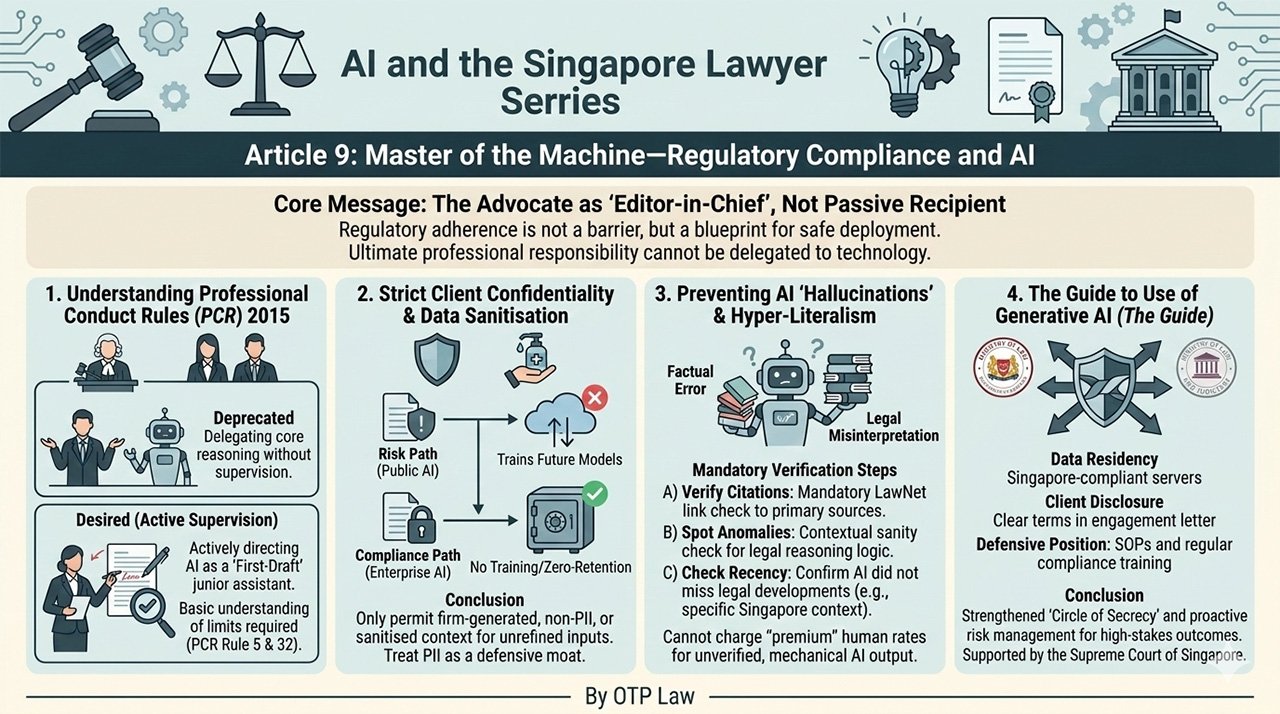
Core Message:
In an era of “hyper-regulation,” AI serves as an indispensable analytical partner, enabling practitioners to monitor legislative shifts and perform gap analyses with a speed and depth that traditional methods cannot match.
For the senior practitioner, regulatory practice is a discipline of constant vigilance. Whether advising on the Personal Data Protection Act (PDPA), MAS Outsourcing Guidelines, or SGX listing requirements, the challenge remains the same: the sheer volume of regulatory “noise.” Guidelines are updated, enforcement decisions are published, and circulars are issued with a frequency that threatens to overwhelm even the most diligent counsel.
In this context, Generative AI should not be viewed merely as a drafting tool, but as a sophisticated regulatory monitor and analytical engine. It allows a small-to-mid-sized firm to provide the kind of comprehensive oversight previously reserved for the specialised departments of larger firms.
The Strategic Value of AI in Compliance and Regulatory Affairs
Regulatory practice involves three core cognitive pillars: monitoring, synthesis, and advisory. AI provides significant leverage across all three, shifting the solicitor’s role from “data harvester” to “strategic advisor.”
1. Automated Horizon Scanning and Monitoring
The primary risk in regulatory practice is the “unknown update.” Missing a single MAS circular or a PDPC enforcement decision can render previous advice obsolete.
- Methodology: Practitioners can deploy AI agents to scrape and summarise daily updates from relevant authorities (e.g., MAS, PDPC, ACRA). By providing the AI with a specific “interest profile” (e.g., “Monitor all updates related to Variable Capital Companies”), the lawyer receives a curated, high-level brief each morning.
- The Benefit: Instead of manually checking multiple portals, the practitioner begins the day with a synthesized report of relevant changes, ensuring they are always at the “cutting edge” of the regulatory landscape.
2. Accelerated Gap Analysis and Compliance Auditing
Comparing a client’s internal policies against a 100-page regulatory framework is a classic “needle in a haystack” exercise.
- Methodology: By uploading a client’s current SOPs alongside a new regulatory guideline (in a secure, enterprise environment), an AI can perform a preliminary “gap analysis.” It can flag sections that are non-compliant or identify required disclosures that are currently absent.
- The Benefit: The AI identifies the 5% of the policy that requires revision, allowing the lawyer to focus their expertise on the high-risk areas rather than the 95% that is already compliant.
3. Drafting “Living” Compliance Policies
Regulatory policies are often stale the moment they are printed. AI enables the rapid generation and updating of bespoke compliance manuals.
- Methodology: Rather than using a generic template, a solicitor can prompt an AI to: “Draft a data breach response plan specifically for a mid-sized fintech firm, incorporating the mandatory notification requirements under the Singapore PDPA and the MAS Technology Risk Management Guidelines.”
- The Benefit: The output is a highly contextualised first draft that reflects the intersection of multiple regulatory regimes.
Navigating the Singapore Regulatory Context
A practitioner must ensure that AI outputs are rigorously grounded in the specificities of Singapore’s highly integrated and evolving regulatory landscape.
- Multi-Agency Intersection: Singaporean regulations often overlap (e.g., a data breach involving a financial institution triggers both PDPC and MAS obligations). AI prompts must be designed to account for this multi-agency oversight.
- Enforcement Nuance: AI is exceptionally good at summarising PDPC Enforcement Decisions. A solicitor can use AI to identify trends in financial penalties for “protection obligation” breaches, providing the client with data-driven risk assessments.
- Advisory Integrity: While AI can draft a policy, it cannot navigate the “unwritten” expectations of a regulator. The practitioner’s role is to ensure that AI-drafted submissions reflect the professional, transparent tone required for effective communication with the relevant authorities.
Comparative Workflow Analysis: Regulatory Advisory
Consider a practitioner advising a client on a new MAS Environmental Risk Management (ERM) guideline:
| Task Phase | Traditional Manual Workflow | AI-Enhanced Workflow |
| Information Gathering | 3 hours: Reviewing the new guideline and related circulars. | 20 mins: Reviewing an AI-generated synthesis of key changes and deadlines. |
| Gap Analysis | 5 hours: Cross-referencing client policies against the guideline. | 1 hour: Reviewing AI-flagged discrepancies and missing controls. |
| Policy Drafting | 4 hours: Drafting a new ERM policy from scratch or old templates. | 1 hour: Refining an AI-generated draft tailored to the client’s specific business. |
| Strategic Advisory | Often limited to a summary of the law. | In-depth consultation on how to integrate compliance into business growth. |
Outcome: The practitioner reduces “production time” by approximately 70%, allowing for a deeper, more strategic engagement with the client’s C-suite.
The “Competency” Mandate (Rule 5) in Regulatory Affairs
Regulatory advice carries immense liability; a missed filing can lead to criminal sanctions for clients. Under Rule 5, competency must be rigorously exercised:
- Reference Verification: AI may conflate the 2012 PDPA with its 2020 amendments. Every statutory reference must be verified against Singapore Statutes Online (SSO).
- Contextual Judgment: A “gap” identified by AI may be a deliberate, risk-mitigated choice by the client. The lawyer must provide the final qualitative judgment on whether a compliance gap represents a genuine legal risk.
- Data Security: Regulatory audits involve sensitive corporate data. Use of public LLMs is strictly prohibited; only enterprise-grade, secure systems satisfy the solicitor’s duty of confidentiality.
Conclusion: From Compliance Officer to Strategic Partner
The modern regulatory practitioner is no longer a mere “gatekeeper” of information. By utilising AI to automate the surveillance and synthesis of the law, the senior lawyer evolves into a strategic partner—one who doesn’t just tell the client what the rules are, but how to navigate them to achieve a competitive advantage.
Next in the Series: We turn to Article 10: AI in Corporate and Commercial Practice—Drafting and Reviewing the Modern Contract.
Disclaimer:
This article is for general information purposes and does not constitute legal advice. Practitioners should consult the latest Law Society of Singapore guidelines and the Legal Profession (Professional Conduct) Rules before implementing new technologies.


