

If you have followed the previous installments of this series, you have likely experienced the “AI velocity” effect: a research task that once consumed a morning now yields results in minutes; a first draft that required hours of manual typing now appears in seconds.
For the practitioner, this efficiency creates a structural dilemma. If your practice is built on the hourly rate, your revenue is inversely proportional to your technological proficiency. The faster you become, the less you earn. This article explores how to navigate this shift—not as a crisis of profitability, but as an opportunity to align your fees with the genuine value you provide to your clients.
The Decay of the “Billable Hour” Logic
The billable hour was designed for a world of manual labor, where time was a reliable proxy for effort. AI disrupts this by automating the “scrivener” work.
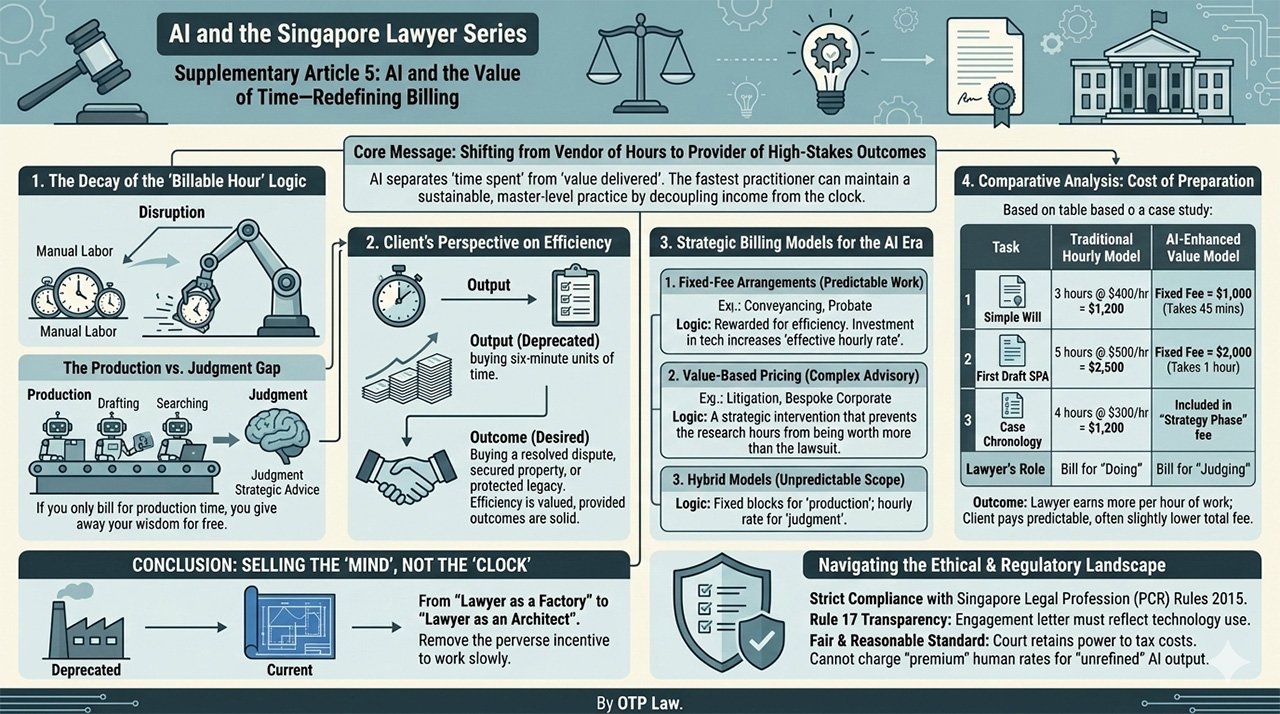
- The Production vs. Judgment Gap: AI handles the production (the drafting and searching), but it cannot provide the judgment (the strategic advice). If you continue to bill only for production time, you are giving away your most valuable asset—your professional wisdom—for free.
- The Client’s Perspective: Clients do not buy “six minutes of a lawyer’s time.” They buy a resolved dispute, a secured property, or a protected legacy. Efficiency is a feature they value, provided it does not compromise the outcome.
Strategic Billing Models for the AI Era
To maintain a sustainable practice, senior practitioners should consider a “Tiered Value” approach to billing:
1. Fixed-Fee Arrangements (The Efficiency Dividend)
For predictable, high-volume work like conveyancing or simple probate, fixed fees are the natural evolution.
- The Logic: If you charge a fixed fee of S$3,000 for a matter, and AI helps you complete it in 3 hours instead of 8, your “effective hourly rate” increases. You are rewarded for your investment in technology.
- The Implementation: Use historical data to set a “Fair Value” fee that reflects the complexity of the task, not just the clock.
2. Value-Based Pricing for Complex Advisory
For high-stakes litigation or bespoke corporate work, move toward pricing based on the impact of the work.
- The Logic: A strategic intervention that prevents a multi-million dollar lawsuit is worth more than the ten hours it took to research the law.
- The Implementation: Frame the engagement around the “Outcome” (e.g., “Strategic Risk Mitigation”) rather than the “Output” (e.g., “10-page memorandum”).
3. Hybrid Models
For matters with unpredictable scopes, maintain an hourly rate for the “judgment” phases but use fixed blocks for the “production” phases.
Navigating the Ethical and Regulatory Landscape
In Singapore, any shift in billing must remain strictly compliant with the Legal Profession (Professional Conduct) Rules 2015:
- Transparency is Non-Negotiable: Under Rule 17, a solicitor must provide a client with a clear explanation of the basis on which fees will be charged. If you are using AI to enhance efficiency, your engagement letter should reflect that the firm utilises advanced technology to deliver high-quality work, and the fee reflects the expertise and infrastructure required to do so.
- The “Fair and Reasonable” Standard: The Court retains the power to tax costs. Whether AI-assisted or not, fees must remain “fair and reasonable” in all circumstances. You cannot charge “premium” human rates for “unrefined” AI output.
- Disclosures: You do not necessarily need to disclose every time you use a “digital drafting clerk” any more than you would disclose the use of a physical precedents book, unless the AI use significantly alters the fee structure or data handling as agreed upon.
Comparative Analysis: The Cost of Preparation
| Task Type | Traditional Hourly Model | AI-Enhanced Value Model |
| Simple Will | 3 hours @ $400/hr = $1,200 | Fixed Fee = $1,000 (Takes 45 mins) |
| First Draft SPA | 5 hours @ $500/hr = $2,500 | Fixed Fee = $2,000 (Takes 1 hour) |
| Case Chronology | 4 hours @ $300/hr = $1,200 | Included in “Strategy Phase” fee |
| Lawyer’s Role | Bill for “Doing” | Bill for “Judging” |
Outcome: The lawyer earns more per hour of actual work, while the client pays a predictable, often slightly lower, total fee.
Communicating Value to the Client
When a client asks, “Why is the fee still the same if you’re using AI?”, the answer should focus on Quality, Speed, and Security:
- “You are paying for the 20 years of experience it takes me to know what to ask the AI.”
- “The AI allows us to be more thorough, checking 1,000 documents for inconsistencies rather than 100.”
- “We have invested in secure, enterprise-grade technology to protect your data, which is reflected in our professional infrastructure costs.”
Conclusion: Selling the “Mind,” Not the “Clock”
The billable hour was an era of the “Lawyer as a Factory.” The AI era is the era of the “Lawyer as an Architect.” By decoupling your income from the passage of time, you remove the perverse incentive to work slowly and create a practice that rewards mastery, precision, and the thoughtful application of technology.
Disclaimer:
This article is for general information purposes and does not constitute legal advice. Practitioners should consult the latest Law Society of Singapore guidelines and the Legal Profession (Professional Conduct) Rules before implementing new technologies.


