

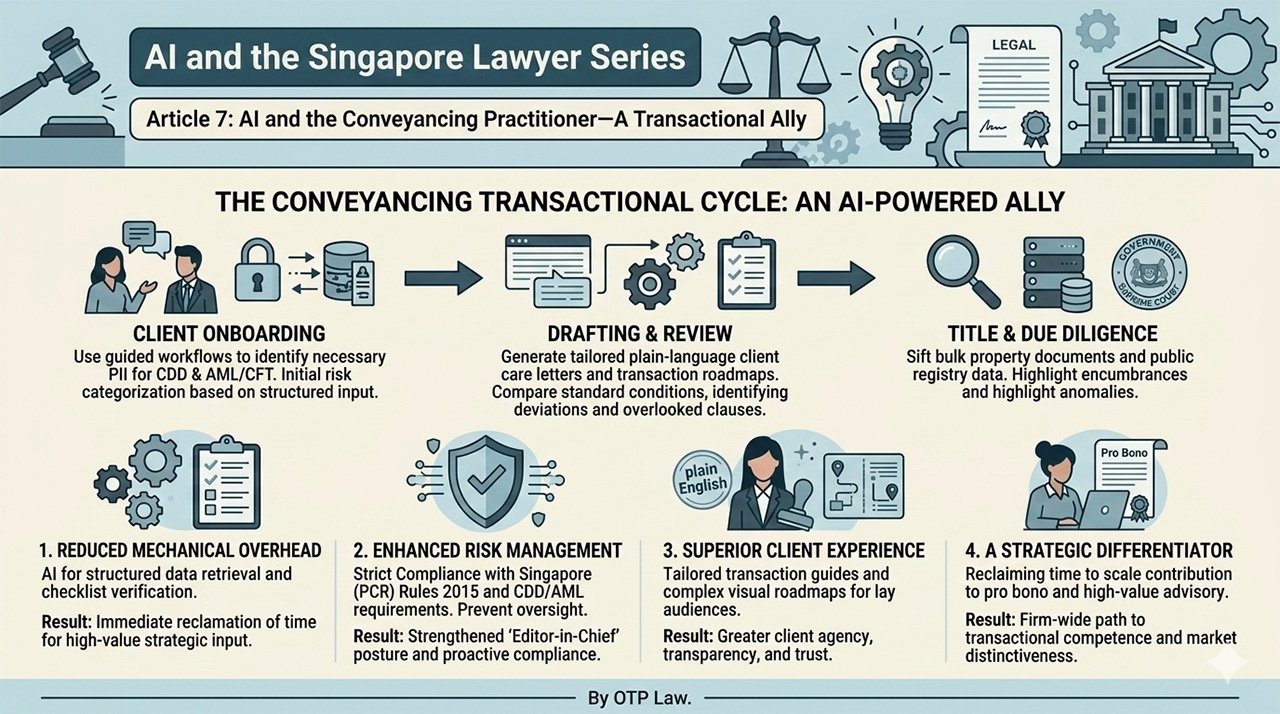
For many small-to-mid-sized practices in Singapore, conveyancing remains the operational backbone. It is a practice area defined by high volume, strict deadlines, and a relentless focus on documentary precision. However, the contemporary practitioner faces a familiar pincer movement: increasingly compressed fee structures on one side, and rising operational overheads on the other.
Generative AI offers a solution to this structural tension. It is not a replacement for the meticulous eye of a conveyancing solicitor, but rather a powerful utility to manage the routine drafting and correspondence that often consumes the majority of a practitioner’s working day.
The Strategic Value of AI in Property Law
Conveyancing is inherently procedural. Whether handling a HDB resale or a private residential purchase, the workflow follows established patterns: the Option to Purchase (OTP), the lodging of caveats, completion statements, and the myriad of correspondence between banks, developers, CPF Board and the counterparty’s lawyer.
This predictability makes conveyancing the ideal candidate for “Standardised AI Workflows.” By applying the roadmap established in Article 6, we can categorise AI’s utility into four primary domains:
1. Accelerated Documentary Drafting
The primary drain on a conveyancing lawyer’s time is the “first cut” of standard documentation. AI can transform this from a manual typing exercise into a structured data-entry task.
- Methodology: Using a structured checklist (Property details, client particulars, price, and special conditions), a lawyer can prompt an enterprise-grade AI to generate a preliminary draft of contract documents or a bespoke set of requisitions. Although seldom required in today’s conveyancing practice, AI will benefit the conveyancer when it becomes necessary to redraft or prepare a sale and purchase agreement (SPA) or an option to purchase (OTP).
- The Benefit: A task that previously required 30 minutes of manual drafting is reduced to a five-minute review-and-edit process.
2. Institutionalised Correspondence
Conveyancing generates significant volumes of routine but essential correspondence—confirmation of receipt of options, requests for redemption statements, and milestone updates to developers.
- Methodology: Firms can develop a “Prompt Library” for these routine communications. For example: “Draft a professional letter to the developer’s solicitors confirming receipt of the signed OTP and notifying them of our intention to exercise on [Date].”
- The Benefit: Consistency in the firm’s professional voice and a significant reduction in the administrative burden on partners and associates.
3. Client Milestone Management
In a competitive market, client service is a differentiator. However, providing manual updates at every stage (e.g., caveat lodged, CPF funds applied for, completion confirmed) is resource-intensive.
- Methodology: AI can take raw matter data and synthesise it into plain-English client updates. This bridges the gap between technical legal procedures and the client’s need for reassurance.
Navigating the Singaporean Context
A Singapore practitioner must ensure that AI outputs align with local statutory requirements and the specificities of our land law system.
- HDB vs. Private Sector: Prompts must be context-specific. An AI must be explicitly instructed to adhere to the requirements and practices of the Housing and Development Board (HDB), in particular to the Housing and Development (Agreements for Sale and Purchase) Rules and/or under the Law Society’s Conditions of Sale 2020, as applicable.
- CPF and Stamp Duty Calculations: While AI is excellent at drafting the structure of completion statements, the final arithmetic and verification against current CPF Board and IRAS rates remain a core professional responsibility.
- The “SSO” Integration: AI should be used to summarise and draft, but every statutory reference must be hyperlinked and verified against primary sources like Singapore Statutes Online.
Comparative Workflow Analysis: A Case Study
Consider the impact on a conveyancing clerk and the lawyer handling a portfolio of 20 active files:
| Task Phase | Traditional Manual Workflow | AI-Enhanced Workflow |
| Email Triage | 60 mins: Drafting individual responses. | 15 mins: Reviewing AI-generated drafts based on brief instructions. |
| Initial Drafting | 45 mins: Manual entry into templates. | 10 mins: Checklist-to-Draft synthesis via AI. |
| Verification | 15 mins: Cross-referencing documents. | 25 mins: Intensive “human-in-the-loop” scrutiny of the AI draft. (by lawyer) |
| Client Updates | 30 mins: Phoning or emailing clients. | 5 mins: Customising AI-generated milestone reports. |
Outcome: The AI-enhanced workflow can potentially save approximately 2–3 hours daily. Crucially, it shifts the lawyer’s time away from production and towards verification and complex problem-solving—where the real professional risk resides.
The “Competency” Mandate (Rule 5)
As senior practitioners, our duty under Rule 5 of the Legal Profession (Professional Conduct) Rules 2015 is non-delegable. When using AI in conveyancing, competency takes a specific form:
- Verification of Data Points: AI might hallucinate a date or a percentage. The solicitor must verify all financial figures and timelines personally.
- Validation of Precedents: Ensure the AI is not inadvertently using foreign common law templates (e.g., UK or Australian) that do not reflect Singapore’s unique land titles system.
- Confidentiality: Strict adherence to “No PII” (Personally Identifiable Information) in public LLMs is mandatory to protect client confidentiality.
Conclusion: Enhancing the Practitioner’s Role
The goal of integrating AI into a conveyancing practice is not to dehumanise the process, but to de-mechanise it. By automating the routine, the senior practitioner is free to focus on the elements of the transaction that truly require legal judgment: navigating complex title issues, advising on stamp duty structures, and managing the interpersonal dynamics of a closing.
Next in the Series: We turn to Article 8: AI in Family Law—Supporting the Human Dimension through Technological Leverage.
Disclaimer:
This article is for general information purposes and does not constitute legal advice. Practitioners should consult the latest Law Society of Singapore guidelines and the Legal Profession (Professional Conduct) Rules before implementing new technologies.


