

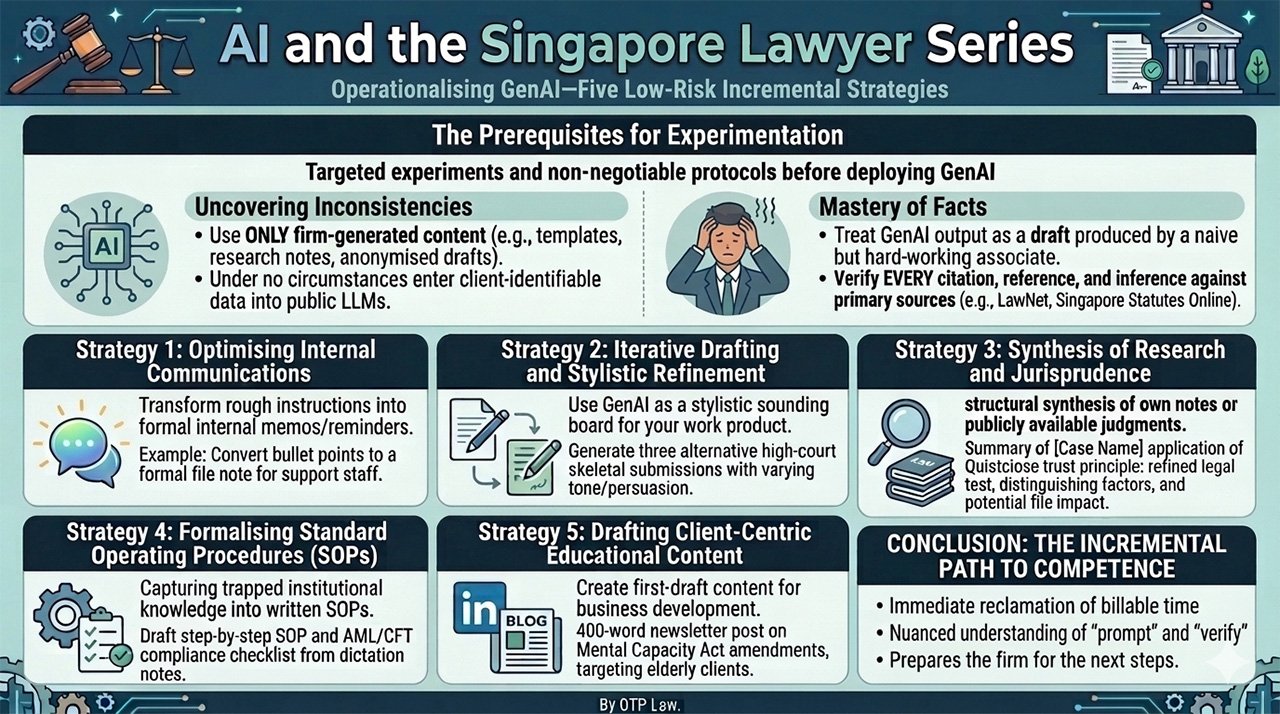
In our preceding discussion, we demystified the probabilistic nature of Large Language Models (LLMs) and established the regulatory boundaries for their use in Singapore. While the theoretical potential of GenAI is vast, the transition from conceptual understanding to operational utility often encounters friction. For practitioners in small firms, the primary deterrent is often the perceived risk-to-reward ratio: the fear of compromising client confidentiality or falling foul of the duty of competence because the user is not familiar with the GenAI tool.
These concerns are valid but manageable. This article outlines five specific, low-risk entry points designed for practitioners. These strategies focus on “non-client-facing” and “administrative-adjacent” tasks, allowing you to build institutional confidence without exposing the firm to professional liability.
The Prerequisites for Experimentation
Before deploying GenAI in any capacity, two non-negotiable protocols must be established:
- Strict Data Sanitisation: For initial experimentation, utilise only firm-generated content (e.g., internal templates, personal research notes, or anonymised drafts). Under no circumstances should client-identifiable data, privileged communications, or sensitive case details be entered into public LLMs.
- The “Inexperienced Associate” Paradigm: Treat all GenAI output as a draft produced by a diligent but legally inexperienced associate. The burden of verification remains with the practitioner (PCR Rule 5). Every citation, statutory reference, and logical inference must be corroborated against primary sources (LawNet, Singapore Statutes Online, etc.).
Strategy 1: Optimising Internal and Administrative Communications
The administrative burden of managing a small practice—coordinating with support staff, file management notes, and internal reminders—is a significant drain on billable time.
The Approach: Use GenAI to transform rough instructions into structured internal communications.
- Example 1: “Convert these bullet points into a formal internal memo to the corporate filing clerk regarding the revised timelines for the Tan matter following the latest ACRA filing delays.”
The Value Proposition: By automating the mechanical aspects of drafting internal correspondence, you reduce the cognitive load associated with firm management, allowing for greater focus on substantive legal strategy.
Strategy 2: Iterative Drafting and Stylistic Refinement
Legal drafting often requires shifting tone—from the aggressive posture of a letter of demand to the conciliatory nuances of a settlement proposal.
The Approach: Use the tool as a “stylistic sounding board” for your own pre-existing work product.
- Example 2: “I have drafted this paragraph for a skeletal submission. Provide three alternative versions that maintain the legal substance but increase the economy of language and adopt a more persuasive, authoritative tone suitable for the High Court.”
The Value Proposition: This is not outsourcing the law; it is refining the advocacy. It allows the practitioner to explore different rhetorical strategies rapidly, selecting the version that best aligns with their professional judgment.
Strategy 3: Synthesis of Personal Research and Jurisprudence
Small-firm practitioners often lack the luxury of dedicated research departments. Summarising complex judgments or personal research notes into actionable insights is a prime candidate for AI assistance.
The Approach: Input your own typed notes or the text of a publicly available judgment (avoiding client-specific context) and request a structural synthesis.
- Example 3: “Based on the Court of Appeal’s decision in [Case Name], synthesise a summary focusing specifically on the court’s application of the Quistclose trust principle. Organise the output into: (i) the refined legal test, (ii) distinguishing factors, and (iii) potential impact on current insolvency files.”
The Value Proposition: You are leveraging the LLM’s strength in pattern recognition to organise your understanding of the law, significantly reducing the time required for file-ready summaries.
Strategy 4: Formalising Standard Operating Procedures (SOPs)
Institutional knowledge in small firms is frequently “trapped” in the minds of senior partners. Converting this into written SOPs is vital for risk management and scalability but is often deprioritised.
The Approach: Dictate or type a rough “brain dump” of a firm process and task the AI with drafting a formal SOP.
- Example 4: “Draft a step-by-step SOP for our firm’s initial conflict check and KYC onboarding process based on these notes: [Insert Notes]. Ensure it includes a checklist for compliance with AML/CFT requirements as per the Law Society’s Practice Directions.”
The Value Proposition: This builds firm-wide consistency and assists in the supervision of junior staff (PCR Rule 32), turning “tacit knowledge” into “explicit assets” with minimal administrative effort.
Strategy 5: Drafting Client-Centric Educational Content
Maintaining a professional profile via LinkedIn or a firm blog is essential for business development but is time-consuming.
The Approach: Provide the AI with a recent legal development and ask for a draft targeted at a specific lay audience.
- Example 5: “Summarise the recent amendments to the Mental Capacity Act into a 400-word informative post for our firm’s newsletter. The audience is elderly clients and their families. Use a professional, empathetic tone and emphasise the importance of a Lasting Power of Attorney.”
The Value Proposition: Content creation becomes an editorial task rather than a drafting one. You provide the expertise; the tool provides the first-draft structure.
Conclusion: The Incremental Path to Competence
The Judiciary and the Ministry of Law have signalled a clear expectation: the modern Singapore lawyer must be “tech-literate.” However, literacy is built through practice, not just observation.
By starting with these five low-risk domains, the practitioner achieves two goals: first, the immediate reclamation of time; and second, a nuanced understanding of how to “prompt” and “verify” AI outputs. This prepares the firm for the next phase of evolution—Agentic AI—where the technology moves from drafting content to executing multi-step workflows.
In the Next Article: We will examine Agentic AI: moving beyond text generation to autonomous task execution, and how this will redefine the “junior associate” role in the Singapore small firm.
Disclaimer:
This article is for general information only and does not constitute legal advice. Practitioners must exercise independent professional judgement when using AI tools and ensure compliance with all prevailing ethical guidelines and Practice Directions.


