

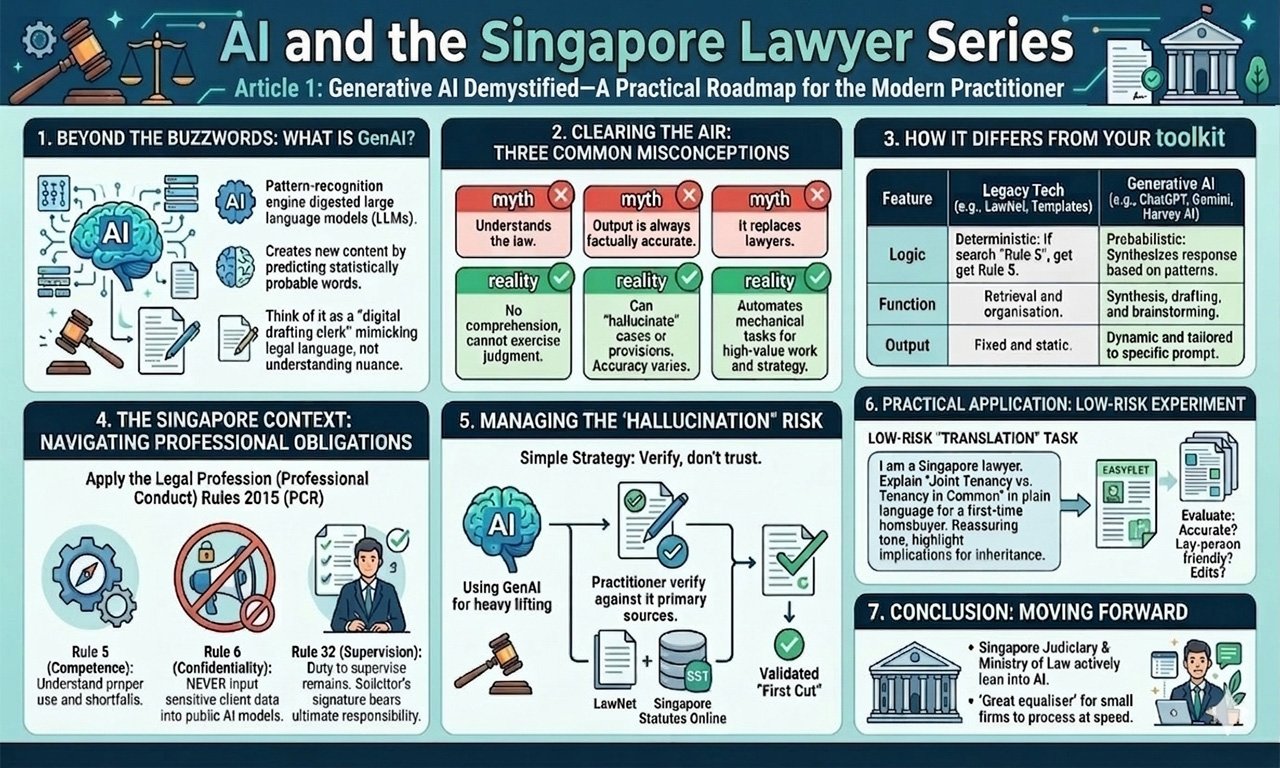
For many of us in small firms or solo practices, the conversation around Generative AI (GenAI) often feels like it belongs in a different world; one of Silicon Valley startups or Magic Circle innovation hubs. However, for a practitioner with a number of years under their belt, GenAI is best viewed not as a futuristic threat, but as a high-performance utility for the here and now.
This 12-part series is designed specifically for the Singapore lawyer. We will skip the hype and focus on how this technology actually functions, its regulatory boundaries, and how you can start using it to reclaim your time for higher-value work.
1. Beyond the Buzzwords: What is GenAI?
At its most basic level, Generative AI is a sophisticated pattern-recognition engine that has digested vast data sets, called large language models (LLMs). Unlike the traditional search function (as an example in LawNet), which retrieve existing documents, GenAI creates new content by predicting the most statistically probable next word in a sequence.
Think of it as a “digital drafting clerk” that has read nearly every public judgment, statute, and legal commentary ever written. It doesn’t “understand” the law with the nuance of a qualified lawyer, but it is exceptionally good at mimicking the structure and tone of legal language. The two key AI tools creating a lot of ‘buzz’ at the moment are:
- Generative AI: Focuses on creating text, summaries, and drafts.
- Agentic AI: A more advanced stage where the AI can execute multi-step tasks (e.g., checking a draft against the Companies Act). We will explore this in another article.
2. Clearing the Air: Three Common Misconceptions
Before integrating GenAI into your workflow, it is essential to dismantle three myths that often stall adoption or lead to misuse:
- Misconception 1: “It understands the law.” It does not. These systems have no comprehension, intent, or awareness. They generate text that looks like understanding because they are excellent at mimicking patterns. They cannot exercise judgment or weigh competing legal considerations.
- Misconception 2: “The output is always factually accurate.” As probabilistic models, they can produce “hallucinations”—confident-sounding but entirely invented case citations or statutory provisions. Accuracy is a variable, not a guarantee.
- Misconception 3: “It is here to replace lawyers.” AI will not replace lawyers who use it, but it may replace some of the work done by lawyers who don’t. The goal is not to automate the lawyer, but to automate the mechanical tasks that distract the lawyer from high-level strategy.
3. How it Differs from Your Current Toolkit
It is helpful to distinguish GenAI from the “Legacy Tech” you likely already use:
| Feature | Legacy Tech (e.g., LawNet, Template Forms) | Generative AI (e.g., ChatGPT, Gemini, Harvey AI) |
| Logic | Deterministic: If you search for “Rule 5,” you get Rule 5. | Probabilistic: It synthesises a response based on patterns. |
| Function | Retrieval and organisation. | Synthesis, drafting, and brainstorming. |
| Output | Fixed and static. | Dynamic and tailored to your specific prompt. |
4. The Singapore Context: Navigating Professional Obligations
Adopting GenAI doesn’t require a new set of ethics; it requires the application of our existing Legal Profession (Professional Conduct) Rules 2015 (PCR) but to a new medium.
- Rule 5 (Competence): Maintaining competence now includes understanding how to use these tools properly—and knowing where they fall short.
- Rule 6 (Confidentiality): This is critical. Never input sensitive client data into public AI models. Treat every prompt as if it were a public statement unless you are using an enterprise-grade, “closed” environment. Check its terms of use.
- Rule 32 (Supervision): The duty to supervise remains with you. Whether a draft is produced by a trainee or an AI, the solicitor whose signature is on the letter or document bears ultimate responsibility.
5. Managing the “Hallucination” Risk
The strategy for a practitioner is simple: Verify, don’t trust. Use GenAI for the “heavy lifting” of drafting and summarisation, but always perform the final verification against primary sources like LawNet or Singapore Statutes Online. Think of the AI’s output as a “first cut” that requires your professional signature to be valid.
6. Practical Application: A Low-Risk First Step
Most practitioners find the greatest immediate value in “translation tasks“—converting complex legal concepts into plain English for clients.
Try this experiment with any base Gen AI tool (using no client-identifiable data):
“I am a Singapore lawyer. Explain the concept of ‘Joint Tenancy vs. Tenancy in Common’ in plain language for a first-time homebuyer. Use a reassuring tone and highlight the implications for inheritance.”
Is the output accurate? Is the concept explained in language that a lay-person can understand or does it require further edits? You might be surprised by the result. You haven’t used any client data. You haven’t relied on the output unless you assess that it is good enough to be used in ‘live’ situations. You’ve simply seen what the tool can do in an area you know well.
7. Conclusion: Moving Forward
The Singapore Judiciary and Ministry of Law are actively leaning into AI. For small firms, GenAI is a “great equaliser,” allowing a solo practitioner to process documents and generate drafts at a speed previously only possible for larger firms.
In the next article, we will dive into Five Low-Risk Ways to Use AI Today, specifically tailored to the workflows of a Singapore practice.
Disclaimer:
This article is for general information only and does not constitute legal advice. Practitioners must exercise independent professional judgement when using AI tools and ensure compliance with all prevailing ethical guidelines and Practice Directions.
Footnote:
Over the next few months, we’ll build on this article creating the “AI and the Singapore Lawyer Series”. Future articles will cover Agentic AI, a practical framework for responsible use of AI and how to use AI to enhance client service. The final few articles will cover use of AI in specific areas of practice like conveyancing, family law, regulatory compliance, corporate, litigation, and estate planning. We have an infographic that condenses this article into a simple to follow diagram.


