

Family law is distinct from almost every other area of practice. Your clients are not merely executing a commercial transaction; they are navigating a profound life transition, often involving high levels of emotional distress and financial uncertainty.
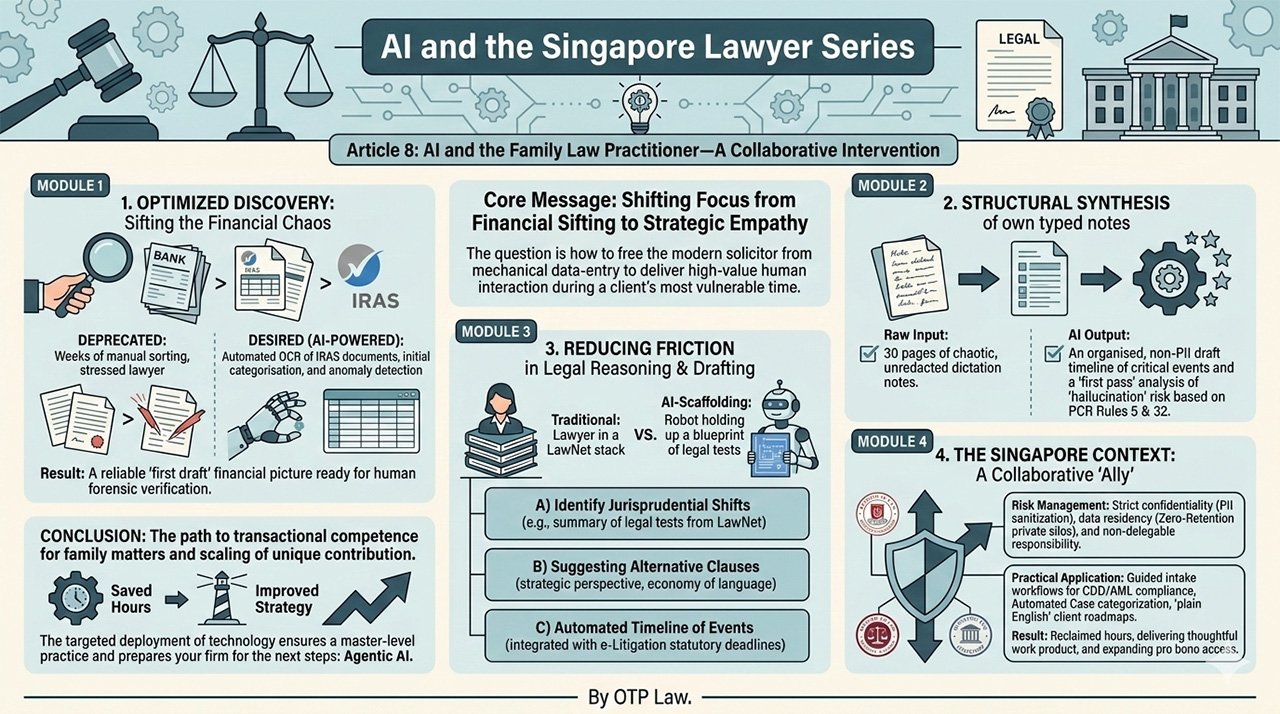
For the experienced practitioner, the challenge is twofold: managing the voluminous, fact-intensive nature of matrimonial proceedings—specifically the Affidavits of Assets and Means (AAM) and complex child-related issues—while remaining an empathetic and present advisor. Here, Generative AI finds its most poignant utility. It does not replace the human touch; it subsidises the mechanical burden so the practitioner can be truly “present” for the client.
The Strategic Value of AI in Matrimonial Practice
The shift toward Therapeutic Justice (TJ) in the Singapore Family Justice Courts emphasizes non-adversarial resolution and the preservation of relationships. AI can support this shift by removing the “friction” from the administrative and drafting phases of a file.
1. Synthesis of Voluminous Financial Disclosure
One of the most labour-intensive phases of a divorce is the review of financial disclosure. Sifting through years of bank statements, credit card bills, and CPF statements to identify assets or dissipation of funds is a task prone to human fatigue.
- Methodology: By feeding data from financial disclosures into a secure, enterprise-grade AI, practitioners can generate structured summaries, asset lists, or even preliminary “Means” tables.
- The Benefit: What previously took a junior associate or clerk several hours of manual data entry can be synthesised into a coherent summary in minutes, allowing the lead solicitor to focus on the implications of the numbers rather than the entry of them.
2. Constructing Detailed Chronologies
Family litigation often hinges on a precise timeline of events—from the date of marriage to specific incidents of conduct or the timeline of child-rearing.
- Methodology: AI is exceptionally adept at taking a chaotic set of client notes, emails, and WhatsApp transcripts and reorganising them into a chronological table of events.
- The Benefit: A structured chronology allows the practitioner to identify gaps in evidence or inconsistencies in the client’s or the opposing party’s narrative much earlier in the process.
3. Drafting “First Cuts” of Non-Contentious Documentation
While every family is unique, many documents—such as Parenting Plans or certain clauses in a Deed of Separation—rely on standard structures.
- Methodology: A solicitor can use AI to generate initial drafts of Parenting Plans or Consent Orders by inputting the agreed-upon parameters (e.g., “Draft a shared care and control arrangement for two children, aged 5 and 8, including alternating weekend access and split public holiday schedules in Singapore.”)
- The Benefit: The practitioner begins with a 70-80% complete draft, shifting the work from “blank page” creation to “expert-level” refinement.
Navigating the Singapore Context: The Family Justice Rules
A family law practitioner must ensure that AI integration respects the unique procedural landscape of the Family Justice Courts (FJC):
- Adherence to TJ Principles: AI-generated correspondence should be reviewed to ensure the tone is firm yet conciliatory, avoiding unnecessarily inflammatory language that complicates the TJ approach.
- Financial Accuracy: While AI can summarise assets, the final verification for the AAM must be absolute. The Women’s Charter and the Family Justice Rules 2024 place a heavy burden of full and frank disclosure on the parties; an AI error in calculation is not a valid defence for non-disclosure.
- Child Issues: AI can draft a schedule, but it cannot assess the “best interests of the child.” Decisions regarding custody, care and control must remain the product of human legal judgment and professional experience.
Comparative Workflow Analysis: Matrimonial File Management
Consider the impact on a practitioner preparing for a Mediation at the Family Dispute Resolution (FDR) Division:
| Task Phase | Traditional Manual Workflow | AI-Enhanced Workflow |
| Document Review | 4 hours: Sifting through 12 months of bank statements to identify assets. | 30 mins: Reviewing AI-generated summary of asset disclosures. |
| Chronology Drafting | 3 hours: Manually building a timeline from client interviews and emails. | 45 mins: Refining an AI-generated chronology of the marriage. |
| Proposal Drafting | 90 mins: Drafting a comprehensive settlement proposal. | 20 mins: Editing an AI-drafted proposal based on specific mediation goals. |
| Client Counseling | Often rushed due to time spent on drafting. Emails filled with legalese. | More time to explain the legal implications and emotional strategy. AI assisted emails with simpler lay-person explanations. |
Outcome: The practitioner reclaims approximately 6–7 hours of “production time” per file, which can be redirected toward the high-value, high-empathy work that defines successful family practice.
The “Confidentiality” Mandate in Sensitive Matters
Under Rule 6, the duty of confidentiality is heightened in family law due to the sensitive nature of the data:
- Strict Confidentiality: Family files often contain sensitive photographs, medical records, or school reports. These should never be uploaded to public LLMs. Only secure, closed-circuit enterprise systems should be used.
- Tone and Nuance: AI often lacks the cultural nuance required for Singapore family dynamics. Every AI draft must be “tempered” by the lawyer to ensure it reflects the specific needs of a local multi-cultural context.
Conclusion: Reclaiming the “Counsellor” in Counsel
The “solicitor and counsel” title we carry is never more relevant than in family practice. By leveraging AI to manage the “mechanical” aspect of family law—the tables, the timelines, and the templates—we are free to return to our primary role: being the calm, strategic, and empathetic guide our clients need during their most difficult chapters.
Next in the Series: We turn to Article 9: AI and Regulatory Compliance—Navigating the Changing Landscape of Professional Ethics.
Disclaimer:
This article is for general information purposes and does not constitute legal advice. Practitioners should consult the latest Law Society of Singapore guidelines and the Legal Profession (Professional Conduct) Rules before implementing new technologies.


