

Over the preceding five instalments of this series, we have established a foundational understanding of the AI landscape:
- Conceptual Clarity: Defining Generative AI as a statistical pattern-recognition utility.
- Low-Risk Entry: Identifying non-sensitive workflows for initial testing.
- Agentic Evolution: Understanding the transition from simple chatbots to autonomous agents.
- Risk Mitigation: Applying a rigorous framework to professional indemnity and ethical obligations.
- Value Creation: Shifting the focus from mere efficiency to enhanced client outcomes.
For the practitioner with significant years of Post-Qualification Experience (PQE), the “novelty” phase of AI has likely concluded. You have experimented with prompts, observed the limitations of various Large Language Models (LLMs), and developed an intuition for where these tools provide genuine utility versus where they falter.
However, intermittent use does not constitute a strategy. To derive true institutional value, a firm must move beyond ad-hoc experimentation. This article outlines the development of a formal AI Roadmap—a strategic document designed to turn technological potential into a disciplined legal practice.
The Imperative of a Structured Roadmap
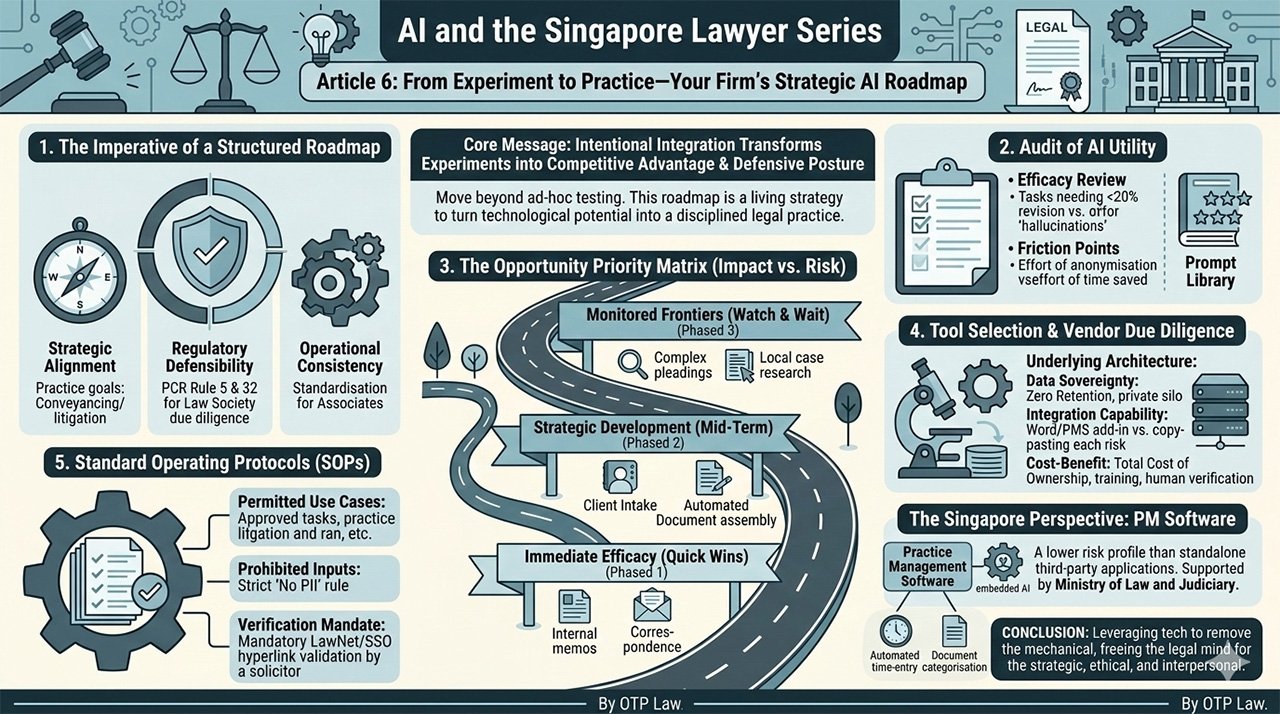
In the absence of a formalised plan, AI adoption in small-to-mid-sized firms tends to be haphazard. Tools are adopted and abandoned based on fleeting interest, and time saved in one area is often absorbed by inefficiencies elsewhere. For the sophisticated practitioner, a roadmap provides three essential pillars:
- Strategic Alignment: Ensuring that technology serves your specific practice goals (e.g., increasing matter throughput in conveyancing vs. deepening research depth in litigation).
- Regulatory Defensibility: Providing a documented trail of due diligence for insurers, the Law Society, and clients, demonstrating how the firm meets its competency duties under Rule 5 of the Legal Profession (Professional Conduct) Rules 2015.
- Operational Consistency: Establishing a “standard of care” for AI-assisted work product across the firm, ensuring that an Associate’s use of AI aligns with the Principal’s risk appetite.
Step 1: The Internal Audit of AI Utility
Before charting a future course, a senior practitioner must conduct a dispassionate audit of the firm’s current technological state. This is not merely a list of tools, but an assessment of “Product-Practice Fit.”
- Efficacy Review: In which specific tasks did AI deliver a “first draft” that required less than 20% revision? Where did the “hallucination” rate render the tool counter-productive?
- Friction Points: Where did the effort of anonymising data or verifying citations outweigh the time saved in drafting?
- Knowledge Gains: What internal “prompt libraries” or templates have emerged as the most reliable?
Step 2: Categorising Opportunities by Impact and Risk
A mature roadmap avoids the “shiny object” syndrome by categorising potential AI applications into a three-tiered priority matrix:
- Immediate Efficacy (Quick Wins): Tasks with high repeatability and low ethical risk. Examples include drafting internal memoranda, summarising non-confidential industry reports, or refining the tone of client correspondence.
- Strategic Development (Mid-Term): Workflows that offer significant leverage but require process redesign. This includes AI-assisted client intake, automated document assembly for standard-form contracts, or integrating AI into existing Practice Management Systems (PMS).
- Monitored Frontiers (Watch & Wait): High-complexity tasks where current LLM reliability remains insufficient for the Singaporean context—specifically, autonomous legal research into local case law or the drafting of complex, bespoke pleadings.
Step 3: Tool Selection and Vendor Due Diligence
For a Singapore law firm, tool selection is a matter of professional liability. When evaluating software, the senior practitioner should look beyond features to the underlying architecture:
- Data Sovereignty and Confidentiality: Does the vendor offer a “Zero Retention” policy? Is the data used to train the global model, or is it siloed in a secure enterprise environment?
- Integration Capability: Does the tool sit within your existing workflow (e.g., an add-in for Microsoft Word or a feature within your Practice Management System), or does it require manual “copy-pasting,” which introduces significant risk of data leakage?
- Cost-Benefit Calculus: Consider the “Total Cost of Ownership,” including the time required for staff training and the cost of human-in-the-loop verification.
Step 4: Establishing Standard Operating Protocols (SOPs)
Sophisticated practice requires that AI usage be governed by clear, written protocols. A one-page SOP for each major tool should define:
- Permitted Use Cases: Specific tasks approved for AI assistance.
- Prohibited Inputs: A strict “No PII” (Personally Identifiable Information) rule for any non-enterprise-grade tools.
- Verification Mandates: A mandatory requirement that every AI-generated citation be hyperlinked to a primary source (e.g., LawNet or Singapore Statutes Online) and verified by a solicitor.
- Disclosure Policy: Guidelines on when and how to disclose AI assistance to clients, aligning with the firm’s engagement letters.
The Singapore Perspective: The Role of Practice Management
The Ministry of Law and the Singapore Judiciary have consistently encouraged the adoption of “legal tech.” For many local firms, the most secure route to AI integration is through established Practice Management Software providers. These platforms are increasingly embedding AI features—such as automated time-entry suggestions or document categorisation—directly into their secure environments. This “embedded AI” often represents a lower risk profile than standalone, third-party applications.
A Practical Illustration: The Boutique Corporate Firm’s Roadmap
Consider a hypothetical three-partner firm specialising in commercial contracts and employment law. Their roadmap might look as follows:
- Audit Result: AI was highly effective for “translating” complex clauses into executive summaries but failed at nuanced negotiations.
- Short-Term Goal: Implement a firm-wide “Prompt Library” for initial contract reviews to ensure consistency across Associates.
- Mid-Term Goal: Transition to an enterprise-grade LLM that allows for the secure uploading of the firm’s own precedents to act as a “knowledge base.”
- Protocol: “No AI-generated draft shall leave the firm without a partner-level review of the underlying statutory references.”
Conclusion: From Novelty to Necessity
The transition from experiment to practice is the hallmark of professional maturity. For the modern Singapore practitioner, a roadmap is not a static document but a living strategy that evolves alongside the technology.
By documenting your approach, you move from a position of reactive curiosity to one of proactive leadership. The goal remains unchanged: to leverage technology to remove the mechanical burdens of practice, thereby freeing the legal mind for the strategic, ethical, and interpersonal complexities that no machine can replicate.
Next in the Series: We conclude our foundational overview and begin our deep dives into specific practice areas, commencing with Article 7: AI in Conveyancing—Streamlining the Property Transaction.
Disclaimer:
This article is intended for general information purposes and does not constitute legal advice. Practitioners should consult the latest Law Society of Singapore guidelines and the Legal Profession (Professional Conduct) Rules before implementing new technologies.


