

Throughout the preceding four instalments of this series, our focus has remained largely on the internal mechanics of legal practice: the reclamation of billable time, the mitigation of administrative friction, and the delegation of routine tasks. These are vital benchmarks of a modern practice. Every hour divested from the “mechanical” is an hour reinvested in the “valuable.”
However, to view Generative AI solely through the lens of efficiency is to overlook its most transformative potential. The true opportunity lies not in performing the same work at a higher velocity, but in elevating the quality of our counsel and expanding the reach of our expertise.
In this article, we explore the transition from efficiency to efficacy.
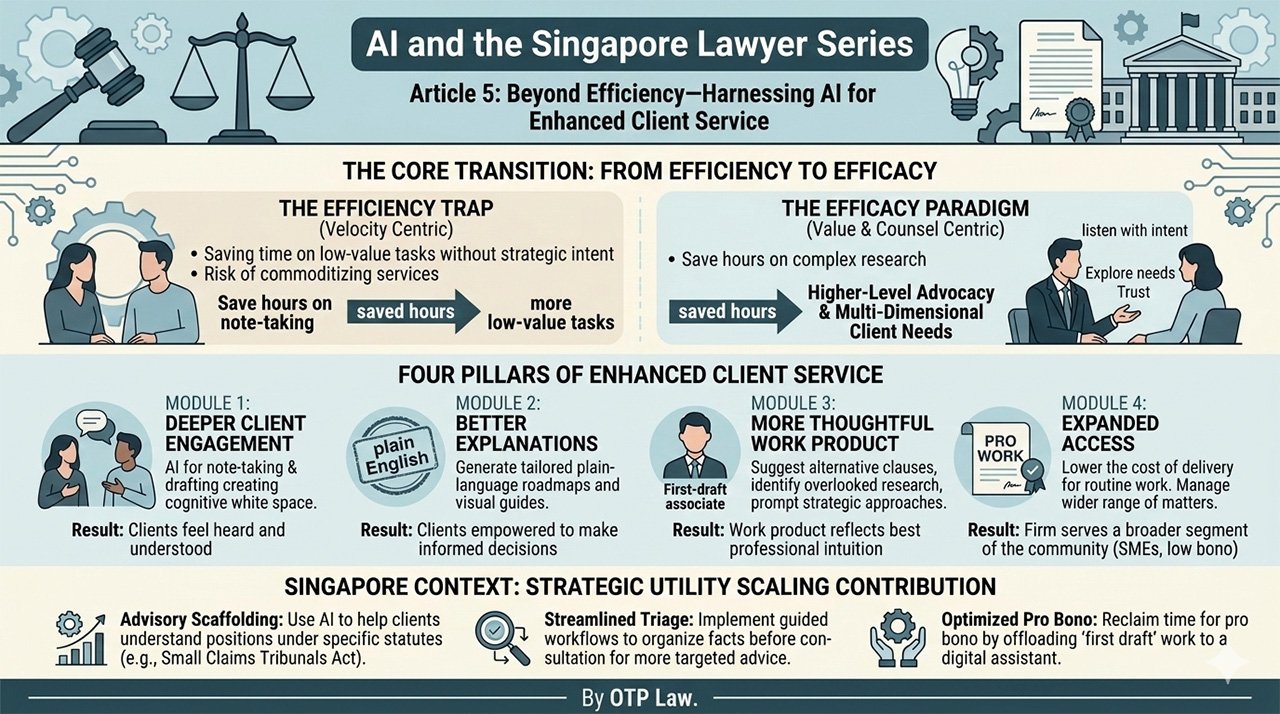
The Efficiency Trap: Velocity vs. Value
Efficiency, while seductive, can be a double-edged sword for the senior practitioner. If the primary objective is simply to produce work faster, we risk commoditising our service rather than refining it. Efficiency-centric thinking often falls into two traps:
- The Goal Post Fallacy: When efficiency becomes an end in itself, we may overlook opportunities to provide more nuanced, bespoke, and attentive service.
- The Parkinson’s Law Effect: Without strategic intention, saved time is often subsumed by more low-value tasks. Efficiency merely creates busyness at a different pace.
The strategic question for the lawyer is not “How can I do this faster?” but “What higher-level advocacy could I undertake if my cognitive capacity were liberated?”
Four Pillars of Enhanced Client Service
AI facilitates a shift in focus toward the aspects of practice that require the most sophisticated human judgment.
1. Deeper Client Engagement
The most effective advocacy occurs when the practitioner is not encumbered by the “next task.” By delegating the mechanical aspects of drafting and note-taking to AI, you create the cognitive “white space” necessary to listen with intent and explore the multidimensional needs of your client.
- Result: Clients feel heard and understood, strengthening the solicitor-client relationship and fostering long-term trust.
2. Better Explanations
The complexity of legal concepts often serves as a barrier to client understanding. AI allows practitioners to rapidly generate tailored client materials—plain-language summaries, strategic roadmaps, and visual explanations—that extend the value of a consultation.
- Result: Clients are empowered to make more informed decisions based on clear, digestible advice that demystifies the legal process.
3. More Thoughtful Work Product
Under the pressure of time, even the most diligent practitioner may rely on familiar templates. AI serves as a “first-pass” associate, capable of suggesting alternative clauses, identifying overlooked authorities in research, or prompting a consideration of different strategic approaches.
- Result: Your work product reflects your best thinking and professional intuition, rather than merely the limits of your available time.
4. Expanded Access
Beyond individual files, AI offers the potential to broaden the reach of a practice. By lowering the “cost of delivery” for routine legal work, practitioners can feasibly manage a wider range of matters—including those that might previously have been economically unviable or too time-intensive to sustain. Such work includes low bono and pro bono work.
- Result: The firm can serve a broader segment of the community while maintaining the high standards expected of a senior practitioner.
The Singapore Context: Strategic Utility
While Singapore’s legal infrastructure is highly developed, many individuals and SMEs still navigate the legal system with limited guidance. AI offers a tool to scale our professional contribution effectively. Imagine:
- Advisory Scaffolding: Using AI-assisted tools to help clients understand their position under specific statutes, such as the Small Claims Tribunals Act, before they even step into your office.
- Streamlined Triage: Implementing guided workflows that help potential clients organise their facts and evidence, allowing you to provide more targeted advice during the initial consultation.
- Optimised Pro Bono: Reclaiming the time necessary to take on more significant pro bono commitments because the “first draft” heavy lifting is handled by a digital assistant.
Case Study: The Evolution of a Solo Practice
Consider “Mei Ling,” a general practitioner in a residential HDB estate. Her clients are the backbone of the community—young families, retirees, and SME owners.
The Pre-AI Paradigm: Mei Ling’s week was a zero-sum game. Every hour spent on complex research for a probate matter was an hour lost to client-facing advocacy. Quality was often a function of her physical stamina.
The Post-AI Paradigm:
- Engagement: During a meeting regarding a complex Will, Mei Ling focuses entirely on the family dynamics. An AI tool records the session (with consent) and produces a structured summary for her review, allowing her to catch nuances she might otherwise have missed while scribbling notes.
- Service Expansion: When an SME owner calls with a minor employment dispute, she uses AI to generate a plain-English guide on the Employment Act in minutes. She provides this as a value-add, ensuring the client is protected without exhausting her billable morning.
- Professional Reach: She uses AI to synthesise recent High Court judgments into brief, accessible updates for her clients, positioning her practice as a modern, proactive firm.
The Question of Authenticity
A common concern is whether AI will render legal work “generic.” In reality, AI trained on general data produces general results. However, AI prompted with your specific insights, reviewed against your high standards, and edited with your professional voice, serves to amplify your unique style, not replace it.
Redefining Professional Success
As we move toward an AI-integrated practice, we must adopt more sophisticated metrics for success. We should look beyond billable hours to qualitative benchmarks:
- Do my clients exhibit a deeper comprehension of their legal position?
- Am I applying my expertise to the strategic core of a matter, or the mechanical periphery?
- Am I able to provide high-quality counsel to a more diverse range of clients?
Strategic Exercise: The “Double-Time” Reflection
Identify a recurring client-facing task. Ask yourself: “If I were granted twice the time to perform this task, how would I elevate it?” Would you add more strategic context? Would you simplify the language further? Now, consider how AI can be the lever that creates that time. This is not about speed; it is about excellence.
Looking Ahead
In our final instalment, we shall synthesise these concepts into a Strategic AI Roadmap for your firm—a pragmatic, actionable framework to ensure your practice remains resilient, ethical, and elite in a changing world.
Disclaimer:
This article is for general information only and does not constitute legal advice. Practitioners must exercise independent professional judgement when using AI tools and ensure compliance with all prevailing ethical guidelines and Practice Directions.


