

Introduction: The Paradigm Shift in Legal Technology
In our preceding discussions, we established the foundational utility of Generative AI (GenAI) as a “digital drafting clerk”—a sophisticated system predicated on pattern recognition and statistical probability. For the practitioner, GenAI has likely transitioned from a curiosity to a functional assistant for discrete tasks: summarising a complex judgment, drafting a preliminary client update, or brainstorming a skeletal outline for a submission.
However, the technological frontier is shifting. We are moving beyond Large Language Models (LLMs) as reactive interfaces toward Agentic AI. This transition represents a shift from “Content Generation” to “Procedural Execution.” While GenAI provides the intellectual raw material, Agentic AI possesses the capacity to act upon that material within defined parameters. For the Singapore practitioner, this distinction is not merely academic; it is the difference between a tool that assists and a system that delegates.
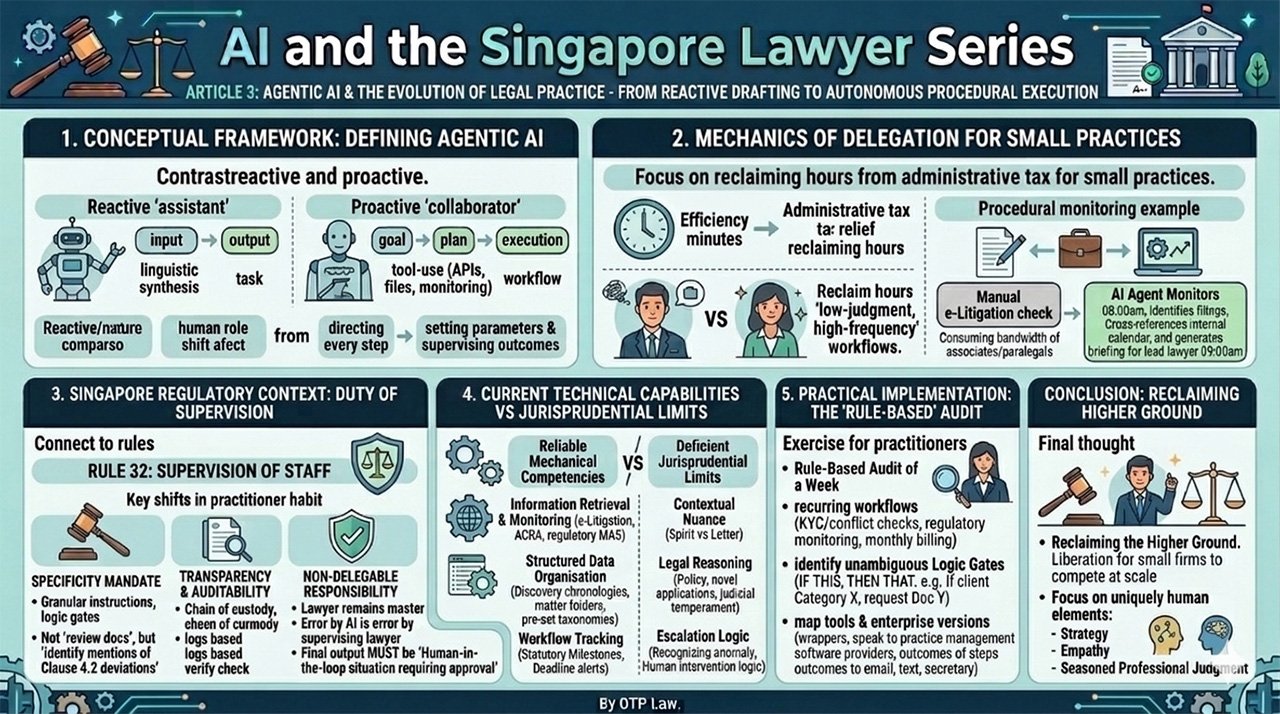
1. Conceptual Framework: Defining Agentic AI
In technical terms, Agentic AI refers to AI systems designed to achieve specific goals by breaking them down into a sequence of autonomous sub-tasks. Unlike standard GenAI, which requires a prompt for every output, an AI Agent operates via a “loop” of reasoning, planning, and execution.
In the context of legal practice, we can categorise the two as follows:
| Feature | Generative AI (The Assistant) | Agentic AI (The Collaborator) |
| Operational Logic | Reactive (Input to Output) | Proactive (Goal to Plan to Execution) |
| Capability | Linguistic synthesis and drafting | Tool-use (APIs, file management, monitoring) |
| Unit of Work | The Task (e.g., “Summarise this PDF”) | The Workflow (e.g., “Manage this document production process”) |
| Human Role | Directing every step of production | Setting parameters and supervising outcomes |
2. The Mechanics of Delegation: Why it Matters for Small Practices
For solo practitioners and small-firm partners, the primary constraint is rarely legal acumen; it is the “administrative tax” of practice management. Agentic AI addresses this by moving from efficiency to true delegation.
While GenAI saves minutes on a draft, Agentic AI can theoretically reclaim hours by assuming responsibility for “low-judgment, high-frequency” workflows. For example, rather than a lawyer manually checking the e-Litigation portal for service updates, an Agentic system can be configured to:
- Monitor the portal at 08:00am daily.
- Identify new filings associated with specific matter numbers.
- Cross-reference these filings against the firm’s internal calendar.
- Generate a high-level briefing for the lead lawyer by 09:00am.
This is not merely a faster way of working; it is the automation of the procedural monitoring that typically consumes the bandwidth of associates or paralegals.
3. Current Technical Capabilities vs. Jurisprudential Limits
It is imperative to maintain a clear boundary between the mechanical and the judgmental. Current Agentic AI is reliable in the former but deficient in the latter.
Reliable Competencies:
- Information Retrieval and Monitoring: Automated tracking of e-litigation and ACRA filings, MAS regulatory updates, or specific case law developments.
- Structured Data Organisation: Sorting unstructured discovery/production volumes into chronologies or matter-specific folders based on pre-set taxonomies.
- Workflow Tracking: Ensuring that a conveyancing or probate matter moves through its statutory milestones, triggering alerts when deadlines approach.
Current Deficiencies:
- Contextual Nuance: Agents struggle to interpret the “spirit” of an instruction if it deviates from the “letter” of the rule.
- Legal Reasoning: Agents cannot weigh competing policy considerations or predict judicial temperament in novel applications of the law.
- Escalation Logic: Without explicit programming, an Agent may fail to recognise when a procedural anomaly requires urgent human intervention.
4. The Singapore Regulatory Context: The Duty of Supervision
The adoption of Agentic AI must be viewed through the lens of the Legal Profession (Professional Conduct) Rules 2015 (PCR). As we move toward more autonomous systems, Rule 32 (Supervision of Staff) becomes particularly relevant.
The Singapore Model AI Governance Framework (issued by IMDA and PDPC) provides a useful scaffold here. It emphasises Human-over-the-loop (supervision) rather than Human-in-the-loop (direct intervention) in some situations. For the practitioner, this necessitates a shift in professional habit:
- The Specificity Mandate: Ambiguity is the enemy of Agentic AI. Instructions must be granular. “Review these documents” is insufficient; “Identify all mentions of Clause 4.2 and flag any deviations from our standard template” provides the necessary logic-gate.
- Transparency and Auditability: Practitioners must be able to explain the “chain of custody” of their AI-supported workflows. If an Agent monitors deadlines, there must be a logs-based system to verify that the check occurred.
- The Principle of Non-Delegable Responsibility: Ultimately, the lawyer remains the ‘master of the matter’. An error by an AI Agent is, in the eyes of the Law Society and the Courts, an error by the supervising lawyer. As such, while ‘human-over-the-loop’ can be a guiding principle as the AI Agent carries out its tasks, the final output must be a ‘human-in-the-loop’ situation requiring approval of the supervising lawyer.
5. Practical Implementation: The “Rule-Based” Audit
To begin integrating Agentic workflows, practitioners should conduct a “Rule-Based Audit” of their typical week. Identify tasks that follow a “If This, Then That” (IFTTT) logic.
Exercise for the Practitioner:
- List Recurring Workflows: e.g., monthly billing, initial KYC/conflict checks, regulatory monitoring.
- Identify Logic Gates: Is the task governed by clear, unambiguous rules? (e.g., “If the client is from Category X, request Document Y”).
- Map the Tools: Research Agentic “wrappers” or enterprise versions of AI tools that offer API integrations with your existing practice management software. If you don’t understand what this means, it is okay. Speak to your practice management software provider.
If you don’t have a practice management software, it is also okay. Just think about where to outcomes of steps 1 and 2 above is going? Is it to an email or to a text messaging tool or to your secretary who then compiles the information and prints it out? The Agentic AI tool can try to replicate that process.
Conclusion: Reclaiming the Higher Ground
The evolution toward Agentic AI should not be viewed with trepidation, but as an opportunity for small-firm lawyers to compete at scale. By delegating the mechanical and procedural to supervised AI Agents, the practitioner is liberated to focus on the elements of law that remain uniquely human: strategy, empathy, and the exercise of seasoned professional judgment.
In our next article, we will move from the conceptual to the defensive, exploring a robust risk-management framework for AI adoption—addressing confidentiality, privilege, and the mitigation of “hallucinations” in an autonomous environment.
Disclaimer:
This article is intended for general informational purposes and does not constitute legal advice. Practitioners must exercise independent professional judgement when using AI tools and ensure compliance with all prevailing ethical guidelines and Practice Directions.


